· 3 min read
A safari in Kenya and Tanzania: what to pack for cold dawns, dusty days and bush flights
Game drives that start at 9 °C in an open vehicle, dusty afternoons at 28 °C and small planes that take one soft bag of 15 kg. What to pack for a safari between June and October.
NBO · JRO
- When
- June–October
- Weather
- 8–28 °C, dry
- Pack
- Neutral colors, a fleece, binoculars
The story
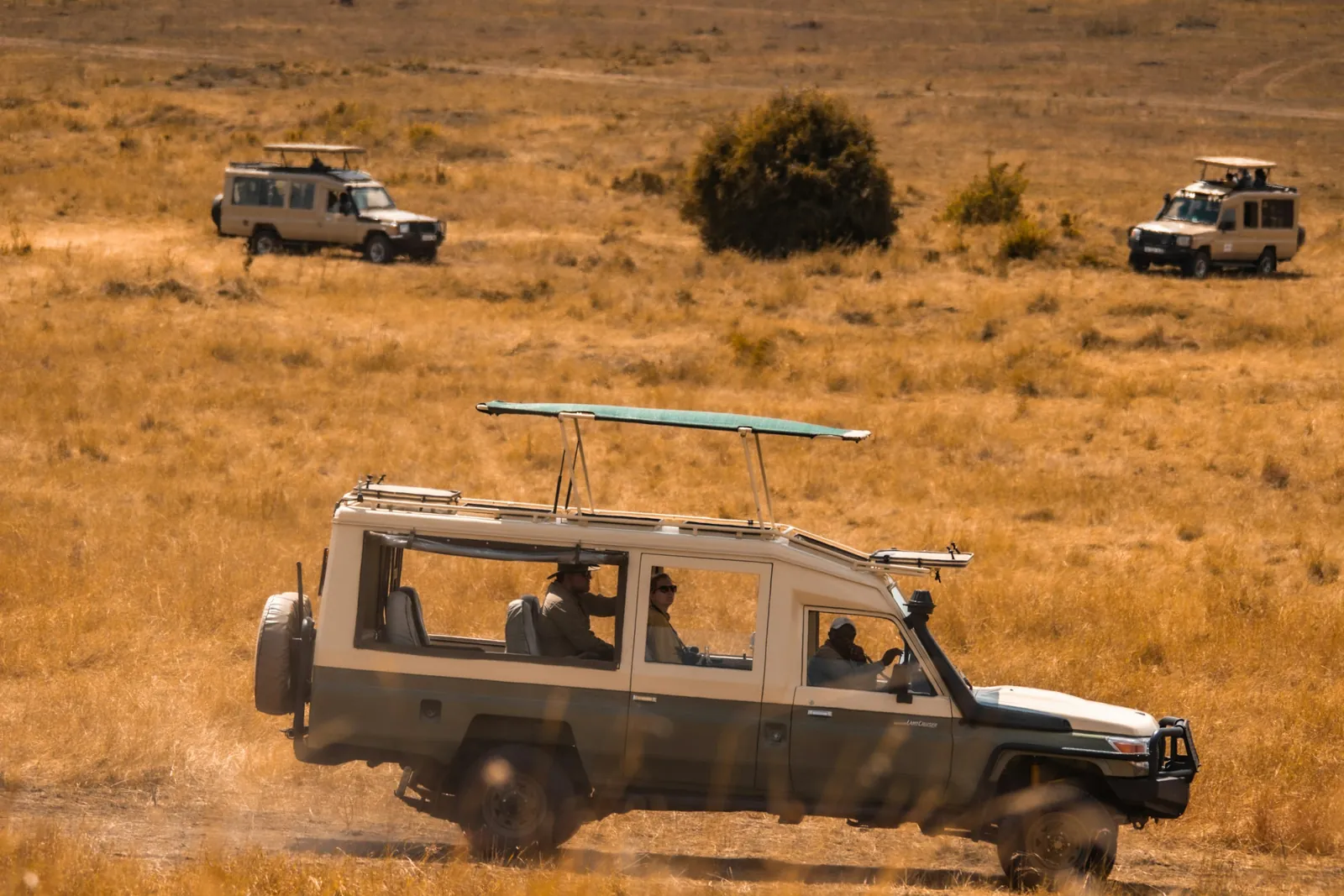
The wake-up call comes at half past five. Outside the tent it’s dark and 9 °C, and hot coffee is waiting by the fire. By six you’re in an open-sided vehicle heading across the Masai Mara, wearing everything you brought: a fleece, a windproof jacket and a hat. The guide says the cold won’t last, and he’s right. By ten you’ve peeled everything off down to a T-shirt, and the sun is strong.
The plains are dry and golden, and dust rises behind every vehicle. The guide stops, and a lioness walks right past the car. You’re glad your clothes are khaki and olive: bright colors stand out, white turns brown in an hour, and dark blue and black attract the tsetse flies you’ve been warned about. You raise your binoculars and watch her disappear into the grass.
In August the wildebeest are in the Mara, hundreds of thousands of them. You wait by the river for most of the afternoon, and the crossing doesn’t happen. The next morning it does.
Later in the trip, a small plane takes you from one park to another. The pilot weighs every bag: 15 kilos per person, hand luggage included, and soft bags only, because hard suitcases don’t fit in the hold. The duffel you chose squeezes in behind the seats.
On the last night, at a lodge on the rim of the Ngorongoro Crater, more than 2,000 metres up, it’s cold enough that you wear the fleece to dinner.
A safari in the dry season means warm, dusty days and cold mornings and evenings. Pack in layers and neutral colors, keep it light enough for small planes, and don’t forget the binoculars.
What to pack
Pack light, in layers and neutral colors, in one soft bag.
Clothes
- T-shirts and long-sleeved shirts in khaki, beige, olive or brown.
- A fleece and a windproof jacket for early-morning and evening drives.
- Light long trousers; long sleeves and trousers at dusk also help against mosquitoes.
- A wide-brimmed hat, and a neck gaiter or scarf for the dust.
- Something warm for evenings at higher camps, such as the Ngorongoro Crater.
Shoes
- Comfortable closed shoes or light hiking boots for walks.
- Sandals for the camp.
For the drives
- Binoculars: one pair each, if you can.
- A camera with a zoom lens, and spare batteries and memory cards.
- A power bank: some camps only charge at set hours.
- Sunglasses, sunscreen and lip balm.
For health
- Insect repellent with DEET or picaridin.
- Antimalarial tablets, if a travel clinic recommends them.
- A small first-aid kit, hand sanitizer and your usual medicines.
Documents, money and tech
- Passport, your travel authorization or visa, and a vaccination certificate if you need one.
- US dollars in recent, clean, small notes for tips.
- A plug adapter: sockets are type G in Kenya and types D and G in Tanzania, at 230 to 240 V.
Good to know
- Weather: from June to October, days are around 24 to 28 °C (75 to 82 °F), and mornings in open vehicles can start at 8 to 14 °C (46 to 57 °F). Camps at altitude, such as those on the Ngorongoro Crater rim, get colder at night.
- The migration: the wildebeest are usually in the Masai Mara and the northern Serengeti from July to October. River crossings are never guaranteed.
- Luggage: light aircraft between parks usually allow 15 kg per person, hand luggage included, in soft bags only.
- Plastic bags: Kenya and Tanzania ban plastic carrier bags; leave them at home, even inside your luggage.
- Health: see a travel clinic four to eight weeks before you go, for malaria and vaccines. Arriving from a country with yellow fever risk, such as Kenya or much of South America, you may be asked for a yellow fever certificate; check the rules for your route.
- Plugs: type G in Kenya; types D and G in Tanzania; 230–240 V.
- Money: Kenyan shilling (KES) and Tanzanian shilling (TZS). US dollars are welcome for tips, but local currency is increasingly expected for other payments, especially in Tanzania; old or damaged dollar notes are often refused.
- Entry: Kenya asks almost every visitor for an electronic travel authorization (eTA), and Tanzania asks many nationalities for a visa. Apply online before you fly.