· 3 min read
Morocco: what to pack for Marrakech, the Sahara and Fez
Warm afternoons in the medina, a mountain pass at 2,260 metres and a night in the desert that turns cold after sunset. What to pack for a trip across Morocco between March and May.
RAK · FEZ
- When
- March–May
- Weather
- 7–32 °C, cold desert nights
- Pack
- Linen, a warm layer, a scarf
The story
In the Marrakech medina, the lanes are narrow, shaded and busy. It’s 26 °C in April, and you’re walking behind a donkey cart, past stalls of lanterns, leather and spices. Your shirt covers your shoulders and your trousers are long and loose; you’re not hot, and nobody gives you a second look. A shopkeeper invites you in for mint tea, and the price of the rug you liked starts high and comes down slowly. That’s how it works here.
The next morning, a minibus takes you over the High Atlas. At the Tizi n’Tichka pass, 2,260 metres up, you get out for a photo: it’s 9 °C, with a cold wind and snow on the peaks around you. Everyone on the bus is suddenly looking for a sweater.
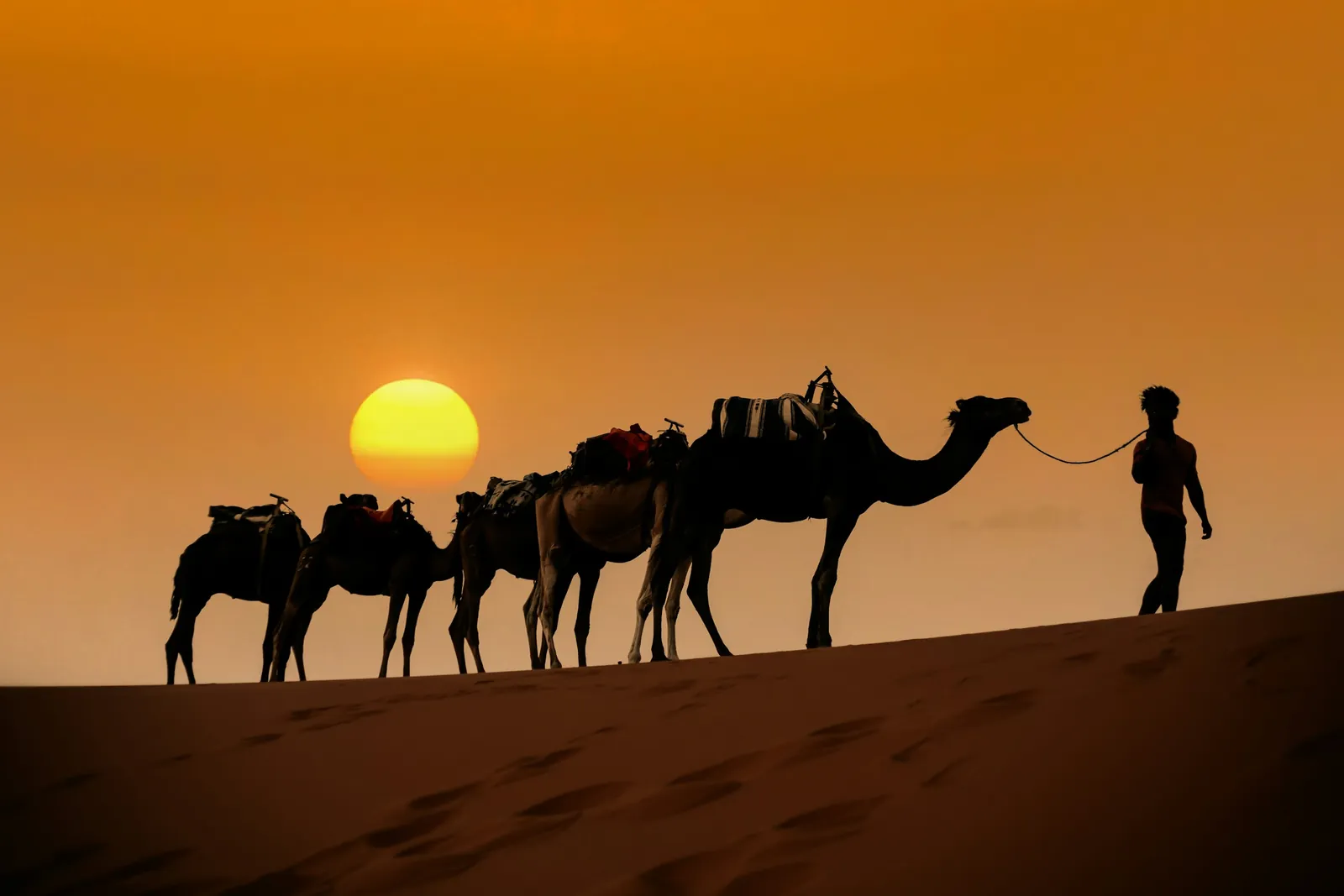
Two days later you reach the dunes of Erg Chebbi, near Merzouga. It’s 30 °C in the afternoon and the sand is orange and fine. You leave your suitcase in the vehicle and take only a small bag for the night. At sunset you ride a camel to the camp, with a scarf wrapped around your face against the blowing sand. After dinner the drums come out, the sky fills with stars and the temperature falls to 12 °C. You pull on a fleece and warm socks, and you’re glad you packed a headlamp for the walk to your tent.
The trip ends in Fez, in a medina so tangled that even the maps give up.
Morocco in spring is warm by day and cool at night, and cold in the mountains and the desert after dark. Light, loose clothes that cover you, one warm layer and a scarf handle almost everything.
What to pack
Pack light, loose clothes that cover your shoulders and knees, then add a warm layer for the mountains and the desert nights.
Clothes
- Light, loose long trousers and long skirts, in linen or cotton.
- T-shirts and shirts that cover the shoulders.
- A fleece or warm sweater, and a light jacket for the Atlas passes.
- Something warm to sleep in at the desert camp.
- A large scarf: for the sun, for the sand, and to cover your hair if you wish.
Shoes
- Comfortable closed shoes for the medinas’ uneven lanes.
- Sandals you can shake the sand out of.
- Warm socks for the desert night.
For the desert
- A small bag for the night at the camp; big suitcases usually stay in the vehicle.
- A headlamp or flashlight.
- Sunglasses, sunscreen and lip balm.
- Wet wipes and hand sanitizer.
Documents, money and tech
- Passport.
- Cash in small notes for the souks, taxis and tips.
- A plug adapter: sockets are types C and E, at 220 V.
- A power bank: charging at desert camps can be limited.
Good to know
- Weather: from March to May, Marrakech and Fez run from about 7 to 29 °C (45 to 84 °F). In the Sahara, days reach 25 to 32 °C (77 to 90 °F) and nights drop to 8 to 15 °C (46 to 59 °F). The High Atlas passes can be cold, with snow on the peaks into spring.
- Respect: clothes that cover your shoulders and knees are appreciated everywhere outside the resorts. Most mosques are closed to non-Muslims. Ask before photographing people.
- Ramadan: its dates move about eleven days earlier every year and sometimes fall in spring; check this year’s dates. During that month, many cafés and restaurants outside the tourist areas close by day.
- Plugs: types C and E, 220 V.
- Money: Moroccan dirham (MAD). You’ll usually only get it in Morocco: change money or use an ATM when you arrive, and keep the receipts to change back what’s left before you leave.
- Entry: many nationalities can visit Morocco without a visa for up to 90 days; check the rules for your passport.