· 6 min read
What to pack for Japan in November: autumn leaves
Mild afternoons, evenings near 7 °C, dark by 5 pm and temples where your shoes come off. What to pack for Japan in November, in autumn-leaf season.
TYO · KYO
Tokyo and Kyoto · Japan
- When
- Mid to late November
- Weather
- 7–17 °C, mostly dry
- Pack
- Layers, slip-on shoes, a scarf
Some links in this post pay Wayboard a commission. Your price is the same.
In mid to late November, Tokyo and Kyoto run from about 7 °C at night to 17 °C in the afternoon (45 to 63 °F), with little rain, and the sun sets before 5 pm. Pack layers you can take off indoors (a sweater and a light padded jacket), a scarf, broken-in shoes that slip off easily, and warm socks for the temples.
The story
At eight in the morning, the ginkgo avenue at Meiji Jingu Gaien in Tokyo is a tunnel of yellow. People stop in the middle of the road for photos, and the leaves pile up along the curb. It’s 10 °C, and you’re wearing a sweater under a light padded jacket. By one o’clock it’s 17 °C, the jacket is rolled up in your day bag, and the heated subway car makes you take off the sweater too.
The next morning you take the shinkansen, the bullet train, to Kyoto with only a day bag. Your suitcase left the day before from the hotel’s front desk, sent ahead to your hotel in Kyoto for a small fee. On the train, you watch a couple try to fit two large suitcases where there’s no room for them, and you’re glad yours is somewhere on a truck.
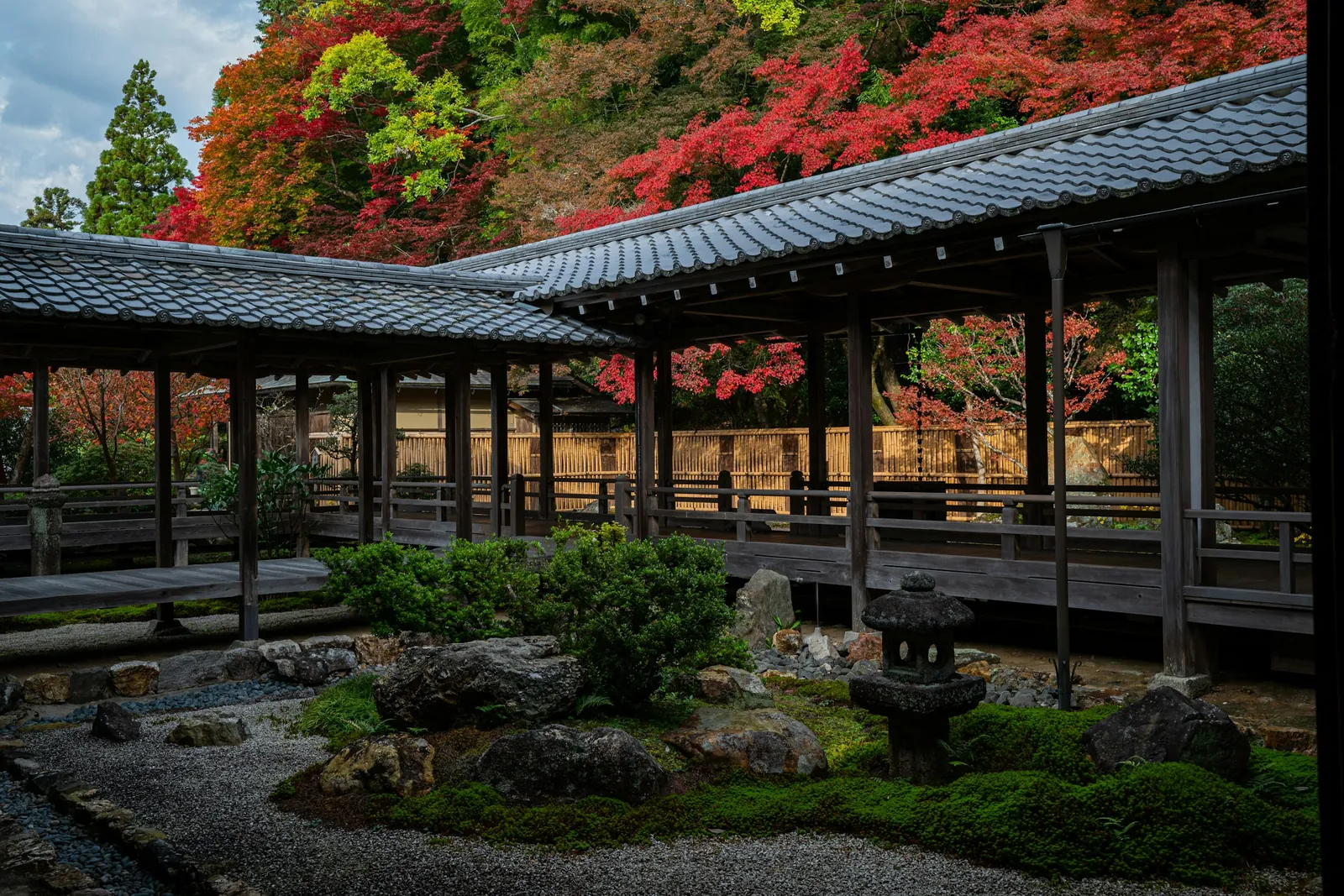
In Kyoto, the maples are at their peak. At Tofuku-ji you cross a wooden bridge over a valley of red and orange leaves, then take your shoes off to walk through the halls. The wooden floors are cold in late November, and you feel every board through thin socks. It’s the fifth time today your shoes have come off, and you stop untying laces: from now on, the slip-on pair.
The sun sets at a quarter to five, and by half past five it’s dark and 9 °C. You join the line outside a temple for its evening light-up, the maples lit from below, and you stand outside for an hour. The scarf you nearly left at home goes on, then the gloves. Afterwards, back in a warm restaurant, everything comes off again.
November in Japan is mild by day, cold after dark, and dark early, with little rain. Pack layers that come off easily on heated trains and in shops, a scarf and gloves for the evenings, and shoes that slip off at every temple door.
What to pack for Japan in November
Pack for a day that starts cool, warms up, and turns cold after dark, with heated trains and temples you walk through in socks.
Clothes
- A light padded or down jacket, for the evenings and the temple light-ups.
- A sweater or fleece, easy to take off on heated trains and in shops.
- A thermal base layer if you feel the cold, for evenings near 7 °C at the end of the month.
- Long-sleeved tops and a couple of T-shirts to layer.
- Trousers comfortable for sitting on the floor in temples and traditional restaurants.
- A scarf, and thin gloves for late November.
- Warm socks without holes: temple floors are wooden and cold, and you’ll walk on them often.
Shoes
- Broken-in walking shoes that slip on and off, without laces to untie at every door. 20,000 steps a day is normal.
- Soles with grip, for stone steps and paths covered in wet leaves.
For the day
- A day bag big enough for the jacket you take off at noon.
- A folding umbrella: November is dry, but showers happen.
- A small bag for your trash. Public bins are rare.
- A reusable bag for your shoes: some temples hand you a plastic one to carry them through the halls.
Documents, money and tech
- Passport. Hotels must see it at check-in.
- A coin purse. Japan uses more cash and coins than most countries, especially at temples and small restaurants.
- A transport card (Suica or PASMO), which can live in your phone’s wallet.
- A plug adapter if needed, and a power bank: maps and photos drain the phone by the afternoon.
- An eSIM or pocket Wi-Fi for maps and translation.
Good to know
- Weather: mid-November runs from about 9 to 17 °C (48 to 63 °F), and late November from 7 to 15 °C (45 to 59 °F), in both cities, by JMA’s 1991–2020 averages for Tokyo and Kyoto. November gets about 96 mm (3.8 in) of rain in Tokyo and 74 mm (2.9 in) in Kyoto, far less than October’s 235 mm (9.3 in) in Tokyo.
| When | Tokyo | Kyoto | What changes in the bag |
|---|---|---|---|
| Early November | 11 to 19 °C (52 to 66 °F) | 10 to 20 °C (50 to 68 °F) | A sweater is enough most evenings |
| Mid-November | 9 to 17 °C (48 to 63 °F) | 8 to 17 °C (46 to 63 °F) | A light padded jacket and a scarf |
| Late November | 7 to 15 °C (45 to 59 °F) | 7 to 15 °C (45 to 59 °F) | Add thin gloves, and a thermal layer if you feel the cold |
- Autumn leaves: by JMA’s 1991–2020 records, the maple it watches in Tokyo turns red around November 28 and the one in Kyoto around December 5. Gardens and hillside temples often color earlier, the dates move each year, and leaf forecasts are published in the autumn.
- Daylight: the sun sets at about 4:30 pm in Tokyo and 4:45 pm in Kyoto by the end of November, by the National Astronomical Observatory of Japan’s tables. Plan outdoor sights for the morning, and the evening for light-ups and dinner.
- Luggage: on the Tokyo–Kyoto shinkansen, bags of 161 to 250 cm (64 to 98 in), length, width and height added up, need a reserved seat with oversized baggage space, booked with your ticket; bigger ones can’t board. Hotels and convenience stores can send your bags to your next stop, usually by the next day, for a small fee.
- Plugs: types A and B, 100 V. North American plugs fit (two-pin ones; three-pin may not). Most phone and laptop chargers handle 100 V; hair dryers and straighteners from 220–240 V countries often don’t.
- Money: Japanese yen (JPY). Cards work in cities, but carry cash.
- Entry: many nationalities can visit visa-free for short stays; check yours on the Ministry of Foreign Affairs of Japan’s list. Registering on the government’s Visit Japan Web before you fly speeds up immigration and customs (checked October 6, 2026).
- Going in spring instead? What to pack for Japan in spring, in cherry-blossom season. First time this far from home? What to pack for your first international trip.
Questions
Is it cold in Japan in November?
Mild by day and cold at night: about 9 to 17 °C (48 to 63 °F) in mid-November in Tokyo and Kyoto, and 7 to 15 °C (45 to 59 °F) by the end of the month. Pack a sweater, a light padded jacket, a scarf, and thin gloves for late November.
When do the autumn leaves peak in Kyoto?
Usually in late November and early December. By JMA’s 1991–2020 records, the maple it watches in Kyoto turns red around December 5, gardens and hillside temples often color earlier, and the dates move each year.
What should I wear in Japan in November?
Layers that come off easily: long-sleeved tops, a sweater or fleece, and a light padded or down jacket, with a scarf for the evenings. Trains and shops are heated, and the sun sets before 5 pm, so you’ll take layers off and put them back on all day.
Can I take a big suitcase on the shinkansen?
Yes, if you book for it: bags of 161 to 250 cm (64 to 98 in), length, width, and height added up, need a reserved seat with oversized baggage space, booked with your ticket, and bigger ones can’t board. Hotels and convenience stores can also send your bags ahead, usually by the next day.
Does it rain in Japan in November?
Not much: November gets about 96 mm (3.8 in) of rain in Tokyo and 74 mm (2.9 in) in Kyoto, far less than October. A folding umbrella is enough.
Book for this trip
- Places to stay Booking.com (opens in a new tab)
- Airport transfers Welcome Pickups (opens in a new tab)
- Tickets and tours Klook (opens in a new tab)
- eSIM data Airalo (opens in a new tab)
- Travel insurance SafetyWing (opens in a new tab)
Wayboard may earn a commission if you buy through these links. Your price is the same.