· 8 min read
What to pack for New Zealand in January: the South Island
22 °C in Queenstown, rain and sandflies at Milford Sound, wind on Roys Peak. What to pack for New Zealand in January on a South Island road trip.
ZQN
Queenstown, Milford Sound and Aoraki/Mount Cook · New Zealand
- When
- January
- Weather
- 9–22 °C, Fiordland rain, strong sun
- Pack
- Rain jacket, fleece, sun hat, hiking shoes, repellent
Some links in this post pay Wayboard a commission. Your price is the same.
In January, Queenstown runs from about 10 to 22 °C (50 to 72 °F), Aoraki/Mount Cook is a little cooler, and Milford Sound gets about 667 mm (26 in) of rain over 16 wet days. The summer sun is strong. Pack layers, a real rain jacket, a fleece, sun protection, insect repellent, and hiking shoes.
The story
You land in Queenstown in the middle of January, pick up the rental car, and remember to keep left. By eleven it’s 22 °C on the lakefront and the sun stings in a way it doesn’t at home: your forearms are pink after one coffee outside. You go back to the car for the hat and the SPF 50, and they stay in your daypack for the rest of the trip.
The next morning you drive to Te Anau and fill the tank, because there’s no fuel or shop between there and Milford Sound, 119 km on. The sky closes in as the road climbs. You wait at the lights of the Homer Tunnel, and on the other side the cliffs are running with waterfalls. Milford Sound is one of the wettest places in the country, and the rain is what fills the waterfalls. You take a cruise on Milford Sound in your rain jacket, then walk along the foreshore, where the sandflies find every bare ankle. Long trousers, a long-sleeved top, and repellent sort it out.
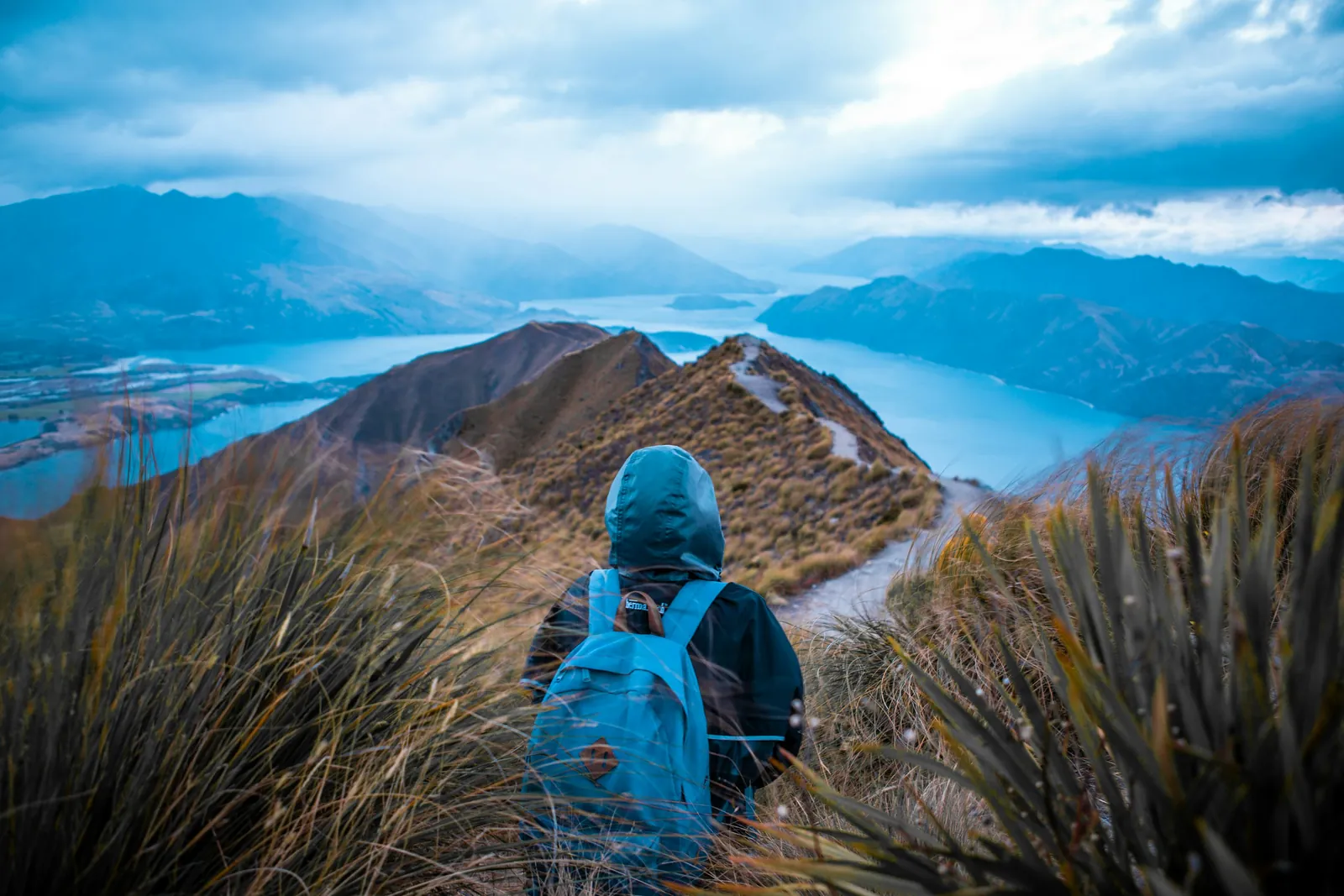
Two days later you’re in Wānaka for Roys Peak: 16 km there and back, 5 to 6 hours, and more than 1,200 m of climbing on a track with no shade and no water. You start at seven with two liters each. By ten the slope is hot and bright; at the summit, 1,578 m up, the wind cuts straight through your T-shirt. The fleece and the windproof jacket come out of the pack, and you eat lunch with your back to a rock, looking down on the lake.
On the last stop, Aoraki/Mount Cook, you walk the Hooker Valley Track: about 10 km return, three swing bridges, and the glacier lake under the mountain. It’s bright at the start and drizzling when you turn back, then sunny again in the car park. Locals call it four seasons in one day, and you’ve had three of them before lunch.
January on the South Island is summer, but a mountain summer: warm days, cool nights, rain that comes and goes, especially in Fiordland, and a sun that burns fast. Pack light layers with a warm one, a rain jacket that really keeps the rain out, sun protection, repellent, and shoes for long walks.
What to pack for New Zealand in January
Pack for warm days, cold summits, rain in Fiordland, and a strong sun, in layers you can add and take off from the car.
Clothes
- T-shirts and a few long-sleeved tops in fabrics that dry fast: long sleeves also stop sunburn and sandflies.
- A fleece or light down jacket, for summits, evenings by the lakes, and nights around 9 to 10 °C.
- A waterproof, breathable rain jacket with a hood: Milford Sound gets rain on about half the days in January.
- Waterproof over-trousers, if you plan to walk in Fiordland in the rain.
- Hiking trousers or leggings, and a pair of shorts for hot afternoons in Queenstown and Wānaka.
- A swimsuit, for the lakes on warm days (the water is cold).
- A warm hat and light gloves, for the top of Roys Peak and early starts.
Shoes
- Hiking shoes or boots with good grip, for Roys Peak and the Hooker Valley: worn in, and cleaned before you fly (see Biosecurity, below).
- Sneakers or sandals for towns and the car.
For the day
- SPF 50 sunscreen, a broad-brimmed hat, and sunglasses: the summer UV is high enough to burn in minutes.
- Insect repellent for the sandflies in Fiordland.
- A daypack with room for the fleece and the rain jacket.
- Two liters of water per person for long walks: there’s no water on Roys Peak.
- Snacks for the drive: no shops between Te Anau and Milford Sound.
For the road trip
- A car phone charger and a power bank: coverage is patchy outside towns.
- Offline maps downloaded before you leave Queenstown.
- A small bag for rubbish, to take it with you on the road.
- In a campervan: a headlamp, a quick-dry towel, and a warm layer for sleeping, since nights are cool.
Documents, money and tech
- Passport, and the NZeTA or visa for your passport (see Entry, below).
- Your driver’s license, with an international driving permit or an approved translation if it isn’t in English.
- A contactless bank card or phone: the Hooker Valley car park doesn’t take cash.
- A plug adapter for type I sockets, with two angled flat pins.
- An eSIM for New Zealand, for maps and road updates.
- Any medicines in their original packaging, with a copy of the prescription.
Good to know
- Weather: by NIWA’s 1991–2020 climate normals, January in Queenstown runs from about 10 to 22 °C (50 to 72 °F), with 72 mm (2.8 in) of rain on about 8 days. At its Milford Sound and Mt Cook stations, the days are a little cooler and the rain far heavier.
| January (NIWA, 1991–2020) | Low | High | Rain | Days with 1 mm or more |
|---|---|---|---|---|
| Queenstown | 9.9 °C (50 °F) | 22.0 °C (72 °F) | 72 mm (2.8 in) | about 8 |
| Milford Sound | 10.7 °C (51 °F) | 19.5 °C (67 °F) | 667 mm (26.3 in) | about 16 |
| Mt Cook | 8.7 °C (48 °F) | 20.4 °C (69 °F) | 419 mm (16.5 in) | about 11 |
- January or February: February has about the same temperatures and less rain, by the same normals: about 467 mm (18.4 in) at Milford Sound, 272 mm (10.7 in) at Mt Cook, and 51 mm (2.0 in) in Queenstown.
- Sun: NIWA says the summer UV index in New Zealand generally peaks around 12, and that a UV index of 12 burns fair skin in about 12 minutes. Cover up from late morning to mid-afternoon, even on cloudy days.
- Milford Sound: by the Department of Conservation (DOC), it’s about 2.5 hours from Te Anau and 4.5 hours from Queenstown one way, with no fuel or shops after Te Anau and patchy phone coverage. Lights at the Homer Tunnel can hold you up to 20 minutes. Check the road status with NZTA before you leave. DOC tells visitors to bring repellent for the sandflies on the foreshore.
- Roys Peak: by DOC, 16 km return, 5 to 6 hours, with more than 1,200 m of climbing to 1,578 m. There’s no water or shade, and the car park fills early. It’s open in January; it closes for lambing from October 1 to November 10.
- Hooker Valley Track: by DOC, about 5 km each way to the lake, with three swing bridges and toilets on the way. Parking at White Horse Hill costs NZD 2.50 per half hour or NZD 25 a day, and cash isn’t accepted (checked November 1, 2026). The weather can change fast at any time of year.
- Getting around: New Zealanders drive on the left. If your license isn’t in English, check NZTA’s rules for overseas licenses before you go.
- Plugs: type I, 230 V and 50 Hz. Most phone and laptop chargers take 100 to 240 V; check the label on anything else.
- Money: New Zealand dollar (NZD). Cards and phones are accepted almost everywhere.
- Entry: citizens of visa-waiver countries, including the US, Canada, the UK, most of the EU, Mexico, Argentina, Chile, Uruguay, and Brazil, need an NZeTA before they fly: NZD 17 in the official app or NZD 23 on the website, plus the NZD 100 International Visitor Levy for most travelers, and it can take up to 72 hours. Australian citizens need neither a visa nor an NZeTA; passports that aren’t on the visa-waiver list, such as Colombia’s and Peru’s, need a visa. Check the list for your passport (checked November 1, 2026).
- Arrival: every traveler, babies included, completes the free New Zealand Traveller Declaration, from 24 hours before the flight until passport control (checked November 1, 2026).
- Biosecurity: the declaration asks about some foods, animal and plant products, and used outdoor equipment, such as hiking boots and tents. Declare them; a false declaration carries a minimum instant fine of NZD 400 (checked November 1, 2026). Clean soil and seeds off your boots before you pack them, and check the Ministry for Primary Industries’ guide for travelers to New Zealand before you go.
- Going on to Australia? What to pack for Sydney in December covers the beaches and the sun. Another summer road trip: What to pack for Iceland in summer on the Ring Road.
Questions
Is it cold in New Zealand in January?
Not in the day: Queenstown runs from about 10 to 22 °C (50 to 72 °F) in January. Nights are cool and summits can be cold and windy, so pack a fleece or light down jacket even in summer.
Does it rain at Milford Sound in January?
Yes, a lot: about 667 mm (26.3 in) on about 16 days, by NIWA’s normals. Pack a waterproof jacket with a hood, and waterproof trousers if you plan to walk.
What are sandflies, and how do I avoid them?
They’re small biting flies, common in Fiordland and around Milford Sound. Wear long sleeves and long trousers, and use insect repellent, especially by the water.
What can’t you bring into New Zealand?
Some foods, animal and plant products, and dirty outdoor gear are biosecurity risks: declare them on the New Zealand Traveller Declaration. A false declaration carries a minimum instant fine of NZD 400, so declare anything you’re unsure about and clean your hiking boots before you fly.
Do I need an NZeTA for New Zealand?
Yes, if you’re a citizen of a visa-waiver country such as the US, the UK, Canada, Mexico, or Brazil; Australian citizens don’t need one. Request it in the official app or on the Immigration New Zealand website at least 72 hours before you fly.
Book for this trip
- Places to stay Booking.com (opens in a new tab)
- Airport transfers Welcome Pickups (opens in a new tab)
- Tickets and tours Tiqets (opens in a new tab)
- eSIM data Airalo (opens in a new tab)
- Travel insurance SafetyWing (opens in a new tab)
Wayboard may earn a commission if you buy through these links. Your price is the same.